



Search for IT outsourcing in Egypt and most of what you find is about Egypt as a destination for foreign companies’ software development and call centres. This guide is about something different: an Egyptian business deciding whether to hand its own IT department, or part of it, to a specialist company. It is the decision we discuss most often with general managers and finance directors, and the questions are always the same. What exactly do we hand over? What do we keep? What does the contract need to say so we are never trapped? And what happens in the first three months?
Below is a practical answer to each of those, written from the side of the business that is buying.
What IT outsourcing means for an Egyptian business
IT outsourcing means a provider takes contractual responsibility for running some or all of your IT: the helpdesk, the servers and network, security, backup, licences, and the projects that keep everything current. You pay a recurring fee and receive defined service levels instead of employing and managing every skill yourself.
There are three common shapes:
- Full outsourcing. The provider becomes your IT department. Typical for companies with no internal IT, or where the only IT person has left.
- Co-managed IT. Your IT person or team stays, and the provider sits behind them with monitoring, escalation, specialists and cover for leave and illness. This is the most common arrangement we see in practice.
- Selective outsourcing. One function goes out, such as the helpdesk, security monitoring, backup or Microsoft 365 administration, while the rest stays in-house.
Outsourcing is closely related to managed IT services; the difference is mostly about how much responsibility moves. If you want the contract-level detail on scope, pricing models and SLAs, read our guide to managed IT services in Egypt.
Why companies in Egypt outsource IT
The reasons are rarely about technology. They are about risk and people.
- One person holds everything. All the passwords and knowledge live in one head. When that person is on leave, ill, or resigns, the business stops.
- Nothing is ever fixed, only patched. The same fault returns every month because everyone is busy answering the last ticket.
- Nobody can answer the audit. A bank, an insurer, a regulator or a large client asks for evidence of controls, and there is no documentation, no restore test and no answer.
- Hiring a full team is not realistic. A business needs a network engineer, a systems administrator, a security specialist and a helpdesk, but cannot justify four salaries.
- Growth across cities. A new branch in Alexandria or Upper Egypt needs support on the ground without opening a local IT office.
What to outsource and what to keep
Outsourcing works best when the boundary is drawn deliberately. As a starting point:
| Usually outsourced | Usually kept in-house |
|---|---|
| Helpdesk and remote support | Ownership of IT budget and priorities |
| Monitoring of servers, network and backups | Relationship with business units and their requirements |
| Patching and vulnerability management | Approval of major changes and purchases |
| Endpoint, email and firewall management | Business application knowledge (ERP processes, workflows) |
| Backup design and restore testing | Final decision on risk acceptance |
| Asset and licence management | Vendor selection sign-off |
| Documentation of the environment | Access to all documentation and admin credentials |
The right-hand column is the point of this table. You can outsource the work without outsourcing control, as long as the business keeps the decisions and always holds a copy of the keys.
How IT outsourcing is priced
Pricing models for outsourced IT in Egypt fall into a few patterns:
- Fixed monthly fee based on users, devices, servers and sites. Predictable, and it gives the provider a reason to prevent problems rather than bill for them. This is how Stark Technology prices IT outsourcing.
- Per user or per device rates, multiplied up each month.
- Dedicated resident engineer placed at your premises full-time, sometimes combined with remote backup from the provider’s team.
- Time and materials, charged by the hour. Flexible, but it gives you no cost certainty and no one is accountable for prevention.
Contract length usually affects the monthly rate; longer agreements are cheaper per month. Projects, such as a migration or a new data room, should always be quoted separately and never buried in the monthly fee. Ask every provider to separate the two in writing.
The contract: seven clauses that protect you
An outsourcing contract should make it easy to stay and possible to leave. Look for these clauses:
- Scope schedule. A list of every service included, with the systems and sites in scope.
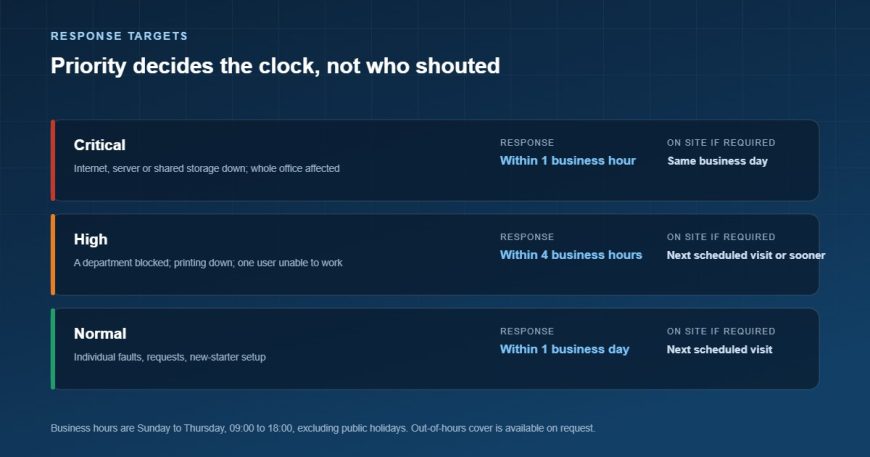
- Service levels. A severity scale with response and resolution targets, cover hours and on-site commitments.
- Reporting. A monthly report on tickets, response times, missed targets, patch status and backup results.
- Ownership of documentation. All diagrams, configurations, passwords and registers belong to you and are kept current.
- Admin credentials. You hold a sealed or vaulted copy of every administrator account, not just the provider.
- Data protection and confidentiality. How the provider’s staff access your systems and data, and what they may not do with it.
- Exit and handover. A defined handover period and a list of what you receive if the contract ends for any reason.
We say this to every client: a client who cannot leave is not a happy client, just a trapped one. If a provider resists the exit clause, take note.
Resident engineer, remote team, or both?
Many Egyptian businesses start by asking for “an engineer on site”. Sometimes that is right: a large office, a factory floor, or an environment with many hands-on requests. But one person on site is still one person. Holidays, illness and resignations come back as your problem, and a single engineer cannot be an expert in networks, servers, security and Microsoft 365 at once.
The model that works best for most mid-sized companies is a remote team handling the volume, with engineers who travel to site when a fault needs hands, and scheduled visits for planned work. Where a site is large enough, a resident engineer can be added on top, backed by the wider team. Stark Technology has engineers resident in Cairo, Alexandria and Assiut, so on-site work in those cities is part of a normal day, and we deliver on site across Egypt.
The handover plan: the first 90 days
Weeks 1 to 4: discovery and takeover
- Inventory of sites, devices, servers, cloud tenants, licences and backups.
- Collection of admin accounts into a secure vault, with shared and former-employee accounts flagged.
- Monitoring and remote-management agents deployed.
- A first restore test, so you know whether the backup actually works.
- A risk summary: what is unsupported, exposed or unprotected.
In our experience, discovery takes about a week and full handover normally completes inside a month.
Weeks 5 to 8: stabilise
- The helpdesk is running through a ticketing portal, and staff know the single way to ask for help.
- Recurring faults are traced to their cause and fixed.
- Patching runs on a schedule and is reported.
- Joiner and leaver processes are written and followed.
Weeks 9 to 12: document and improve
- As-built documentation is delivered and reviewed with you.
- A security baseline is agreed and applied.
- A one-page roadmap is presented: what to replace, what to keep, and what can wait.
A checklist for comparing IT outsourcing companies in Egypt
- Do they offer co-managed IT, or only full outsourcing?
- Where are their engineers physically based?
- Is the fee fixed, and is the included scope written down?
- Will they put response targets in the contract and report against them?
- Do you receive and own the documentation and admin credentials?
- Do they test backup restores, and can they show the record?
- Which vendors are they partners with (for example Microsoft, Fortinet, Dell or VMware), and does that shorten escalations?
- Can they handle compliance evidence if a client or auditor asks, for example for ISO 27001?
- Will they tell you when not to spend money?
For a structured way of scoring providers against each other, see How to choose an IT provider in Egypt.
Related guides
- Managed IT services in Egypt: the complete buyer’s guide
- Choosing an IT support company in Cairo
- Choosing a cybersecurity company in Egypt
- What an honest IT asset inventory actually finds
Frequently asked questions
What is IT outsourcing?
IT outsourcing is when a business hands responsibility for running some or all of its IT, such as the helpdesk, infrastructure, security and backup, to a specialist provider under a contract with defined service levels.
Is IT outsourcing cheaper than hiring an IT team in Egypt?
For most small and mid-sized companies it costs less than employing the range of skills needed, because the provider shares specialists across clients. The bigger benefit is continuity: leave, illness and resignations stop being your problem.
Will we lose control of our IT if we outsource?
Not if the contract is written properly. Keep budget and change approval in-house, hold your own copy of admin credentials, and make sure all documentation belongs to you.
Can we outsource only part of our IT?
Yes. Selective outsourcing, such as only the helpdesk, security monitoring or backup, is common, and co-managed IT lets your internal team keep day-to-day ownership.
What happens to our current IT employee?
Usually they stop firefighting and focus on projects and the business applications they know best, while the provider handles volume, monitoring and specialist work.
How long should an IT outsourcing contract be?
Twelve months is a common starting point. Longer terms usually lower the monthly fee, but only commit for longer once the exit and handover clauses are clear.
What should happen when the contract ends?
You should receive all documentation, admin credentials, asset and licence registers and configuration backups within a defined handover period.
Find out what you could hand over
Since 2016, Stark Technology has designed, built and run IT for organisations in Egypt, with engineers in Cairo, Alexandria and Assiut. Tell us what your IT looks like today and where it hurts, and an engineer will tell you what is worth outsourcing and what is not. The assessment is free and comes with no obligation.
Request a free IT assessment · WhatsApp us · Call +20 122 224 9390

