


Every request logged. Nothing lost in a WhatsApp thread.
A ticket system and a client portal come with every managed services agreement. Your team raises requests in one place, sees where each one stands, and gets a monthly report of what actually happened.
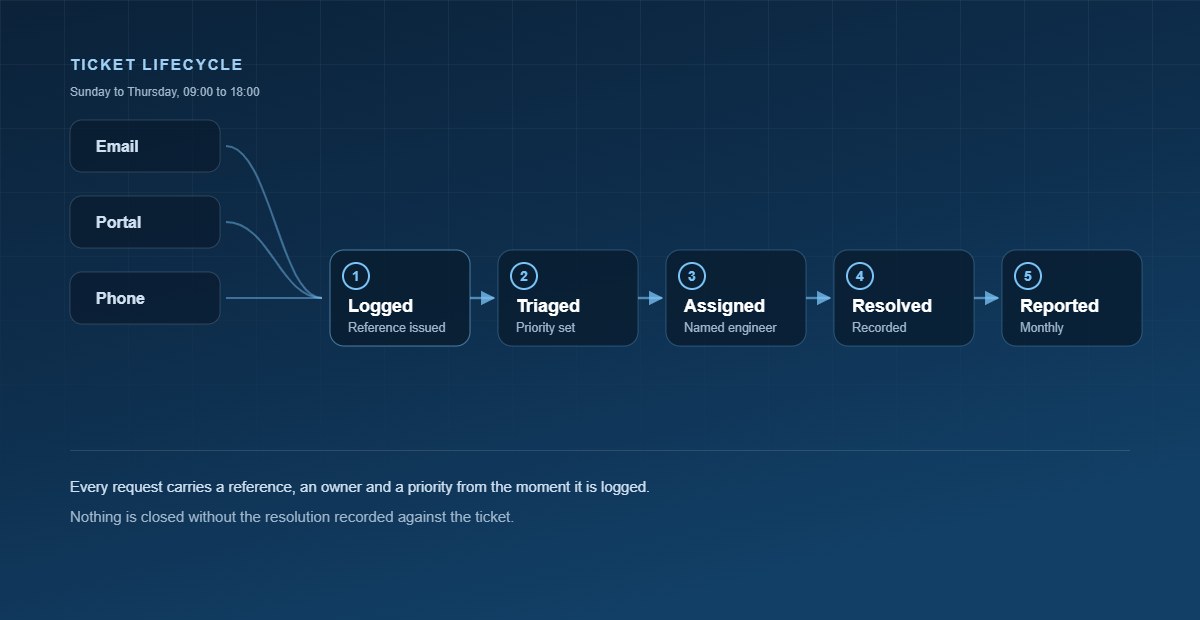
A support desk you can see into
- Raise a ticket by email, through the portal, or by phone — all three land in the same queue
- Every request gets a reference, an owner and a priority, visible to you from the moment it is logged
- Agreed response and resolution targets by priority, measured rather than promised
- Full history per ticket: what was asked, what was done, by whom, and when
- Asset and user context attached to the ticket, so the engineer is not asking which machine again
- Approval steps for changes and purchases, recorded against the ticket
- Monthly reporting: volumes, categories, response times, and the recurring issues worth fixing at the root
Priority decides the clock, not who shouted
Targets are in the service agreement, measured against the ticket record, and reported to you monthly.
Critical
Internet, server or shared storage down; whole office affected
Response within 1 business hour. On site the same business day if it cannot be fixed remotely.
High
A department blocked; printing down; one user unable to work
Response within 4 business hours. On site at the next scheduled visit or sooner.
Normal
Individual faults, requests, new-starter setup
Response within 1 business day. On site at the next scheduled visit.
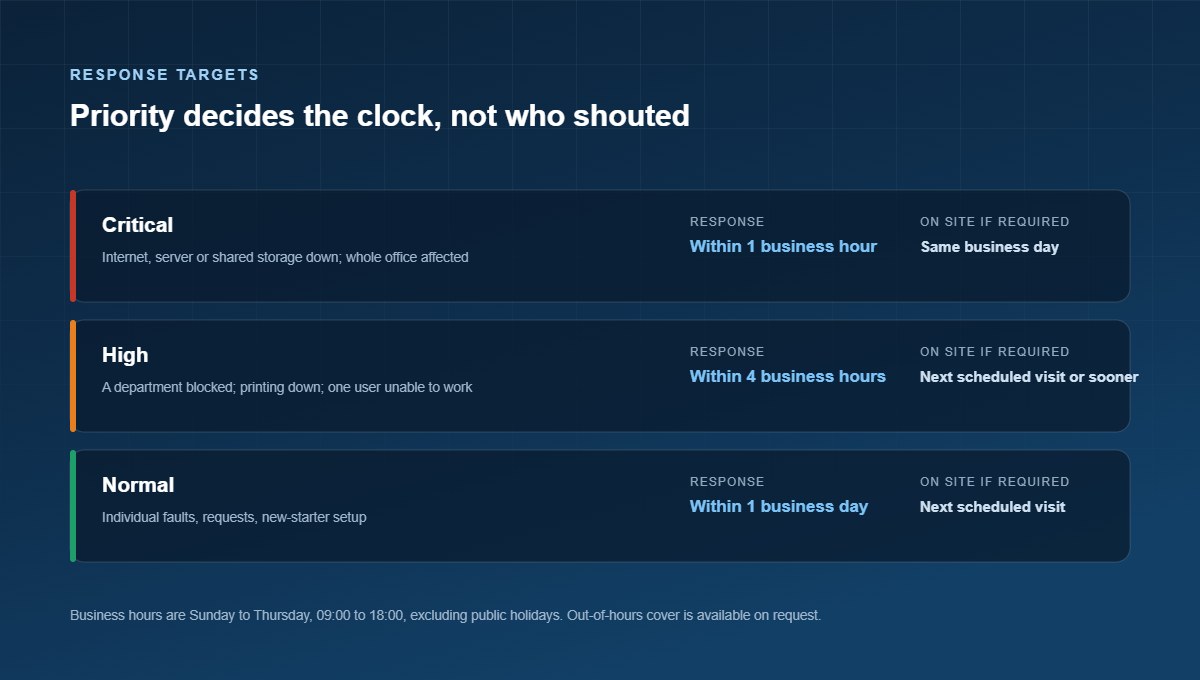
Out-of-hours and public-holiday cover can be added, priced separately, and only if you ask for it.
Three things an unmanaged support process costs you
Almost every company we take on is running support through personal messages and phone calls to whoever answers.
No record
When support lives in chat threads, nobody can answer what was requested, what was agreed, or whether it was ever done.
No priority
The loudest request gets handled first rather than the most damaging one. Ticketing forces the triage that people avoid.
No pattern
The same fault recurs monthly and nobody notices, because nothing counts it. Reporting turns repeat tickets into a root cause.
From request to closure
1. Raised
Email, portal or phone. Logged with a reference immediately, so there is a record from the first minute.
2. Triaged
Priority set against the agreed matrix — impact and urgency, not who shouted. You can see the priority and challenge it.
3. Worked
Assigned to an engineer, with remote support or an on-site visit as the fault requires. Updates go on the ticket.
4. Closed and reported
Closed with the resolution recorded, and rolled into the monthly report so trends are visible rather than anecdotal.
Common questions
Is the portal an extra cost?
No. The ticket system and portal are part of the managed services agreement, not a separate line.
Can our staff still just phone?
Yes, and many do. The engineer logs the ticket for them, so the record exists either way.
Can we see the tickets ourselves?
Yes. The portal shows your open and closed tickets, their status and their history. Managers can see everything raised across the company.
Do you report on it?
Monthly, in writing — volumes, response times against target, and the recurring issues we think are worth fixing properly.
What about Horus?
Horus is our own IT operations platform, currently in build — ticketing, assets, lifecycle, monitoring and vulnerability management in one product. Managed clients will move onto it as it is released. See Horus.
Ask what your support process is missing.
If you cannot say how many requests your team raised last month, that is the gap. Call and we will show you what the reporting looks like.